Somewhere between fumbling for keys in the dark and hearing about a friend’s new keyless setup, the question comes up: should you get a smart lock? It sounds convenient, maybe a little futuristic, and also like something that could go wrong at the worst possible time. Both reactions are fair, and the real answer depends on how you actually use your front door.
What a Smart Lock Actually Does
At its core, a smart lock replaces your key with something else, a code, a fob, an app, or sometimes a fingerprint, to unlock your door. Most models still have a traditional keyhole as a backup, so you’re rarely fully dependent on batteries or a phone. What changes is how you and anyone else you allow gets in day to day.
The Real Benefits of a Smart Lock
No more lost keys. If your household has ever dealt with a lockout because someone forgot their key, a code-based lock removes that specific problem entirely.
Temporary access without copying keys. Dog walker coming by, a contractor working on the house, a guest staying for the weekend. A smart lock lets you set a temporary or one-time code instead of handing out a spare key you’ll need to track down later.
Remote control when you’re away. Many smart locks let you lock or unlock the door from your phone, which is useful for letting someone in while you’re not home, or double-checking you actually locked up before a trip.
A record of who came and went. Some models log entry activity, which can be reassuring if you want to know when your kids got home or when a service provider arrived.
What a Smart Lock Doesn’t Solve
A smart lock changes how you unlock the door. It doesn’t fix a weak door frame, a hollow door, or a deadbolt that wasn’t installed well in the first place. If your current setup has a physical security issue underneath the lock itself, a smart lock upgrade won’t address that on its own. It’s also worth thinking through what happens during a power outage or dead battery. Most smart locks have a physical key backup for exactly this reason, but it’s worth confirming before you commit to a model.
Is a Smart Lock Right for Your Home?
A few questions can help you decide:
Do you own or rent? Homeowners have an easier time here, since you can install hardware permanently. Renters should check with a landlord first, and may want a model that doesn’t require permanently modifying the existing lock.
How often do other people need access? If you regularly have guests, service providers, or family members who need to get in without a key, a smart lock solves a real, recurring hassle.
Do you travel or work away from home often? Remote lock and unlock features tend to matter most for people who want peace of mind about their door while they’re not there.
How comfortable are you with the technology? Some models are simpler than others. If you’d rather not deal with an app or Wi-Fi setup, a keypad-only model without smart features might be a better fit than a fully connected one.
What Installation Involves
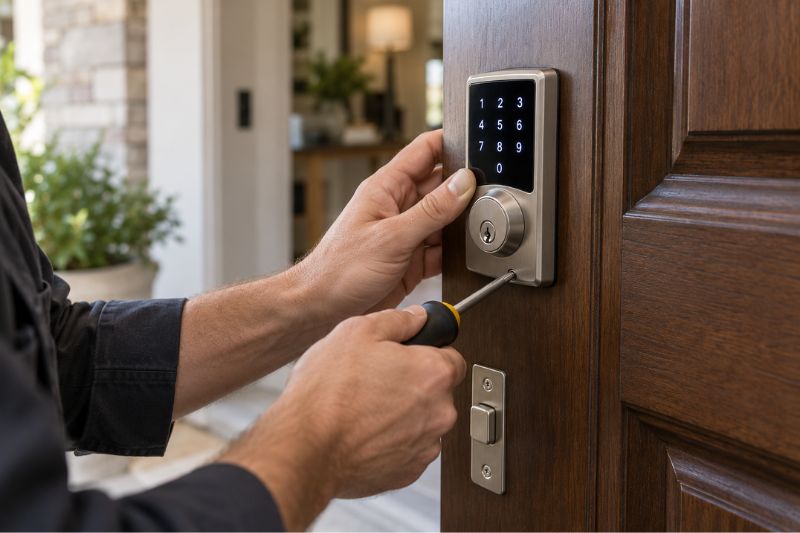
Installing a smart lock is similar in scope to installing any new lock: removing the old hardware and fitting the new one to your existing door. Where it can get more involved is pairing the lock to an app or home system, if the model you choose has one. As a mobile locksmith service, Blacklock Locksmith handles the physical installation at your home, and our lock installation and repair section covers what to expect from that part of the process. If you’re not sure which type of lock fits your situation, our residential locksmith services page covers the full range of options we work with.
Serving Los Angeles Homes
Whether you’re set on a smart lock or still deciding between that and a traditional upgrade, we install both across Los Angeles. You can see the specific neighborhoods we serve on our service areas page.
Frequently Asked Questions
Do smart locks work during a power outage? Most models run on battery power, not household electricity, and include a physical key backup as well, so a power outage alone typically doesn’t lock you out.
Can a smart lock be installed on any door? Most standard residential doors can accommodate a smart lock, though the exact fit depends on your door’s current hardware. It’s worth having this confirmed before purchasing a specific model.
Are smart locks harder to break into than traditional locks? Security depends more on the build quality and installation than on whether it’s “smart.” A well-installed traditional deadbolt and a well-installed smart lock can offer comparable physical security.
What happens if the battery dies? Most smart locks warn you well before the battery is fully dead, and nearly all include a physical key or backup power option so you’re not locked out.
Can I keep my old keys as a backup even with a smart lock? Many models are designed exactly for this, letting you use either the code, app, or a physical key depending on the situation.
Thinking About Upgrading to a Smart Lock?
Whether you land on a smart lock or a traditional upgrade, Blacklock Locksmith can walk you through the options and handle installation at your home anywhere in Los Angeles. Visit our Contact Us page or call to talk it through.