
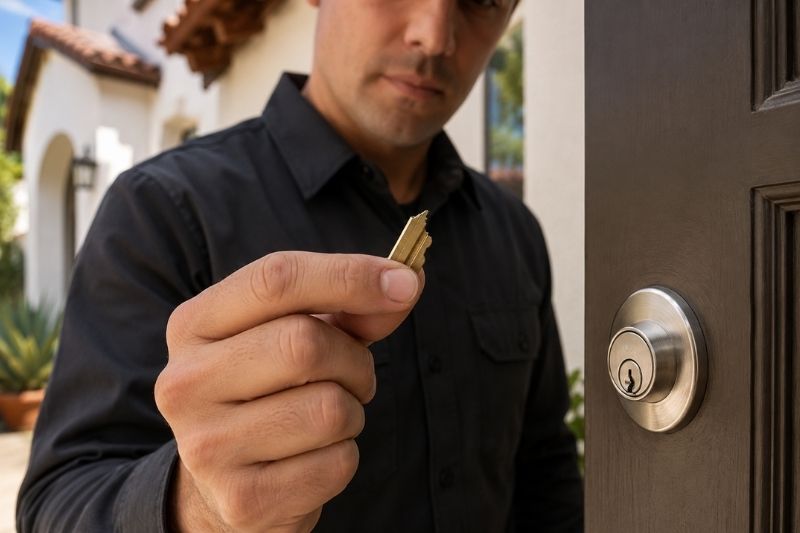
You turn the key like you have a thousand times before, and this time something’s different. There’s resistance, then a snap, and now half your key is still in your hand while the other half is stuck inside the lock. It’s a frustrating moment, but it’s also a common one, and it has a straightforward fix.
Why Keys Break in the First Place
A key snapping usually isn’t random bad luck. A few things tend to be at work:
Metal fatigue. Keys flex slightly every time they’re used, and over years of turning, that metal weakens. A key that’s been on your ring for a decade is far more likely to snap than a newer one.
A worn or dirty lock. If the lock itself is gritty, corroded, or worn down inside, it takes more force to turn the key, and extra force is exactly what pushes a weakened key past its limit.
Low-quality duplicates. Keys cut at a kiosk or from softer blank stock don’t always hold up as well as an original manufacturer key. If a duplicate feels thinner or more flexible than your original, that’s worth paying attention to.
Forcing a stiff lock. Cold weather, a misaligned door, or a lock that simply needs cleaning can all make a key harder to turn. Pushing through that resistance instead of addressing the cause is one of the most common ways a key ends up breaking.
What Not to Do When a Key Breaks
The instinct is to try to get it out yourself, and that’s understandable. But a few common attempts tend to make things worse rather than better:
- Don’t try to grab the broken piece with pliers or tweezers and yank it out. This often pushes the fragment deeper or scratches the internal pins.
- Don’t insert a second key or any other tool into the same keyway to try to “fish” it out. This can jam the mechanism further.
- Don’t force the door or try to turn the remaining stub. If any part of the key is still seated in the lock, forcing it can bend internal components.
The safest move is simply to stop, step back, and figure out your next step.
What to Do Right After a Key Breaks
- Stop touching the lock. Leave the broken piece where it is rather than attempting removal.
- Check for another way in, if you have one, so you’re not stuck waiting outside. A spare key, another entry point, or someone with access can buy you time.
- Call a mobile locksmith. This is where a service that comes to you matters. Instead of trying to solve a delicate mechanical problem yourself, a locksmith brings the right tools directly to your door.
If this happens during a moment where you’re locked out entirely, our Emergency Locksmith Services page covers what to expect when you call.
How a Locksmith Removes a Broken Key
Professional extraction tools are built specifically for this. A broken key extractor is a thin, hooked tool designed to reach past the fragment, grip it, and draw it straight out along the same path it went in, without forcing anything sideways or damaging the pins. In most cases, this is quick, doesn’t damage the lock, and the same lock can be used again once a new key is cut.
Should You Replace the Lock After a Broken Key?
Not always, but it’s worth asking. If the lock was already old, gritty, or had been sticking for a while before the key broke, extraction fixes the immediate problem but not the underlying one. In that case, it may be worth pairing the extraction visit with a broader look at the lock itself. Our lock installation and repair section covers what that process looks like if a repair or replacement makes sense for your situation.
Preventing Broken Keys in the Future
A few habits go a long way toward avoiding a repeat:
- Get duplicates cut from your original key, not from another duplicate, since quality degrades with each generation.
- If a lock has been feeling stiff or gritty, don’t just push through it. A little lock lubricant or a professional cleaning can prevent a lot of wear.
- Replace keys that look worn, thin, or bent before they fail on you.
- If a lock is sticking because the door itself has shifted or settled, that’s worth having looked at separately from the key.
Serving Los Angeles Homes and Businesses
A broken key doesn’t wait for a convenient time, and neither do we. Blacklock Locksmith is a mobile locksmith service, which means we bring extraction tools and lock expertise directly to you anywhere across Los Angeles. You can see the areas we serve on our service areas page.
Frequently Asked Questions
Can a broken key always be removed without damaging the lock?
In most cases, yes. Professional extraction tools are designed to remove the fragment without harming the internal mechanism, though a lock that was already worn may need further attention afterward.
How long does broken key extraction usually take?
It depends on the lock and how the key broke, but it’s typically a quick, focused repair rather than a lengthy process once a locksmith is on-site.
Do I need a new lock, or just a new key?
Usually just a new key, cut once the broken piece is removed. Replacement only becomes necessary if the lock itself was already failing.
What if part of the key is broken off deep inside the lock?
This is still generally recoverable with the right extraction tools. It just may take a bit more care depending on how far in the fragment is.
Can this happen with any type of lock?
Yes, though it’s more common with older keys, worn locks, or lower-quality duplicates. Well-maintained locks and quality keys reduce the risk significantly.
Dealing With a Broken Key Right Now?
If a key has snapped off in your lock, don’t try to force it out yourself. Blacklock Locksmith is a mobile locksmith service that comes to you anywhere in Los Angeles. Visit our Contact Us page or call to get help headed your way.