
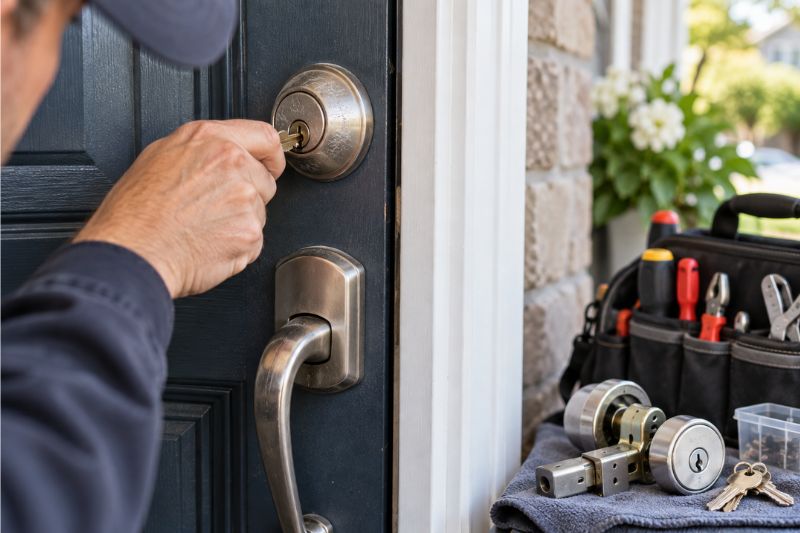
You know the routine. Key in, a little jiggle, lift the handle, nudge the door with your hip, and eventually it gives. Most people live with a lock like that for months. Then one evening it doesn’t give, and you’re standing on the porch holding a bag of groceries and a key that suddenly seems very useless.
A lock that sticks is rarely random. Something is wearing, shifting, or loosening, and the lock is the part of the door that complains first. Here’s how to read the signs, what you can safely try yourself, and how to tell whether you need a repair, a rekey, or a replacement.
What a Struggling Lock Is Trying to Tell You
Locks seldom fail without warning. The warnings are just easy to shrug off. Watch for any of these:
- The key needs jiggling, wiggling, or a bit of muscle to turn.
- The deadbolt moves slowly or stops partway through its throw.
- The knob or handle wobbles, rattles, or spins without doing anything.
- The door only latches if you pull or slam it.
- The key itself looks worn smooth or slightly bent.
Each symptom points somewhere different, which is why the right fix changes from door to door.
Common Causes, in Plain English
Grit and wear inside the cylinder
Every time a key goes in, tiny pins inside the lock shift into place. Over the years, dust and metal shavings collect, and the parts that once glided start to drag. This is the classic “it used to be smooth” lock.
A door that has moved
Doors are not as fixed as they look. Hinge screws loosen, frames settle, and wood swells and shrinks with the weather. Once the bolt no longer lines up with the hole in the strike plate, the lock takes the blame for what is really an alignment problem.
There’s an easy way to check. Open the door and turn the key or thumb-turn. If the bolt slides out smoothly with the door open but binds once it’s closed, the lock may be fine and the door is the culprit.
A tired key
Keys wear down, and copies of copies are worse. A key cut from another duplicate can be just slightly off, and slightly off is enough to make a good lock feel stubborn. If you have a spare, try it. A smooth turn with the spare tells you the original key is the problem.
Loose hardware
Screws on handles, lock bodies, and strike plates back out gradually. A loose handle can throw the internal parts out of position and make the lock feel gritty even though nothing inside is broken.
What You Can Safely Try First
A few small steps cost nothing and sometimes solve the whole thing:
- Try your spare key to rule out a worn key.
- Tighten the visible screws on the handle, lock body, and strike plate.
- Run the open-door test described above.
- Add a small puff of dry lubricant made for locks, such as graphite or a PTFE-based spray. Skip heavy oils and all-purpose sprays, which tend to attract dust and turn gummy over time.
Then stop. If the key feels like it might bend or snap, do not force it. A key that breaks off inside the cylinder turns a nuisance into a bigger job. We explain why that happens, and what to do about it, in our post on why a key breaks in a lock.
Repair, Rekey, or Replace: How to Decide
Repair makes sense when one part is the problem and the rest of the lock is in decent shape. A loose handle, a misaligned strike plate, or a cylinder that needs cleaning and lubrication all fall here.
Rekey is the answer when the lock itself works well but the keys are the issue. Maybe you lost one, maybe you just moved in, maybe an ex-roommate still has a copy. Rekeying changes the lock so old keys no longer work, without swapping out the hardware. Our guide on rekeying versus replacing after a move goes deeper, and the Rekeying & Lock Changes section of our services page lays out what’s involved.
Replace is the better call when the lock is old, visibly damaged, or has needed fixing more than once. If you’ve patched the same lock twice, a third repair is usually a sign to stop patching. Replacement is also the natural moment to upgrade, whether that’s a sturdier deadbolt or a keypad or smart lock. If that last idea appeals, read whether a smart lock is worth it for your Los Angeles home first. You can see what we handle under Lock Installation and Repair.
Why Waiting Costs You
A sticking lock is more than a daily annoyance. The worst case is a lock that finally gives up while you’re on the wrong side of the door. The other worst case is one that looks locked and doesn’t actually secure the door. Neither shows up on a convenient day.
If you’re already in that spot, with the door stuck shut or a key snapped off in the cylinder, skip the troubleshooting and see our emergency locksmith services.
Mobile Locksmith Service Across Los Angeles
Blacklock Locksmith is a mobile service, so there’s no shop to drive to and no need to take the door off its hinges. We come to your home. That includes Valley neighborhoods like Sherman Oaks and Studio City, and the rest of the communities listed on our service areas page.
Frequently Asked Questions
Is it okay to spray WD-40 into a sticking lock?
It’s best to avoid it. It may loosen things for a day or two, but the residue can collect dust and make the problem worse later. Graphite or a dry lubricant made for locks is the safer choice.
Why does my lock stick more on hot or humid days?
Weather changes the size of your door. Wood swells with moisture, metal expands with heat, and the bolt can end up nudged out of line with the strike plate. If the trouble comes and goes with the weather, alignment is the first thing to suspect.
Can a loose door handle be fixed, or does it have to be replaced?
Sometimes a tightening is all it takes. Other times a worn internal part means the whole handle set should go. A quick look at the hardware settles it.
If my deadbolt is the problem, do I have to change the doorknob too?
No. They’re separate locks, and one can be perfectly healthy while the other struggles. If you’d like a single key to work for both, they can be rekeyed to match.
How can I tell if it’s the lock or the door?
Try the lock with the door open. Smooth when open and stiff when closed points to the door or frame. Stiff either way points to the lock.
Ready to Stop Wrestling Your Front Door?
Tell us what the lock has been doing. We’ll look at it, say plainly whether it needs a repair, a rekey, or a replacement, and take care of it at your door. Call Blacklock Locksmith at (818) 305-0460 or reach us through our contact page.