
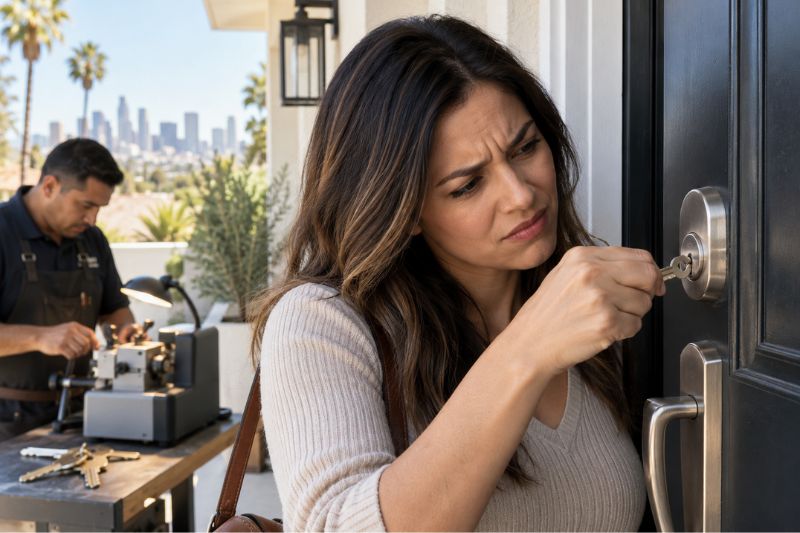
You paid a few dollars, carried the shiny new key home, and slid it into the lock. It goes in. It might even turn, if you hold the door a certain way and say the right words. Or it doesn’t turn at all, and now you’re doubting a piece of metal that looked perfect in the shop.
A copied key that won’t work is one of the most common small headaches in home security, and it has a short list of causes. Most of them are easy to spot once you know what to look for.
Why a Copied Key Fails
It’s a copy of a copy
Every key cut carries a tiny margin of error. One copy is usually close enough. A copy of that copy adds its own error on top, and a copy of that one adds more. After a few generations, the key can sit just far enough off the original pattern that the lock’s pins refuse to line up. The lock didn’t change. The key drifted.
The original was worn
A key that’s been used daily for years has rounded edges and shallower cuts. Duplicate it, and the copy inherits all that wear, sometimes with a fresh layer of imprecision. Worn originals produce sluggish copies, and the lock gets blamed for it.
The blank was wrong
Keys start as uncut blanks, and there are many shapes. A blank that looks right but has a slightly different profile can slide into the lock and still bind halfway. This is especially common with lookalike keys that are a hair too thick or thin for the keyway.
The cut left rough edges
Cutting can leave tiny metal burrs along the key. Those burrs catch on the pins inside the lock and make the key feel gritty or stiff. A key that grabs when you push it in, then loosens up after a few uses, often has this problem.
The machine was slightly out of alignment
Duplicating machines depend on accurate clamping and calibration. If the original was seated a touch crooked or the machine has drifted, every cut on that key is off in the same direction.
What to Try Before You Blame the Lock
- Compare the copy to the original. Hold them side by side against a light. Differences in depth or spacing are often visible.
- Try the original in the same lock. If the original turns smoothly and the copy doesn’t, the lock is fine.
- Check for burrs. Run a fingernail along the cut edge. Anything that catches is a clue.
- Use a dry lubricant, not oil. A puff of graphite or a PTFE-based lock spray is gentler on a stiff lock than a household spray, which can gum up the pins.
- Don’t force it. A key that needs muscle can snap off, and then you have a bigger problem. Our post on why a key breaks in a lock explains how that happens.
And please don’t file or bend the key yourself. A copy that’s slightly off rarely improves with freehand adjustments, and you can wreck the key or the lock.
Not Every Key Is Easy to Copy
Plain brass house keys are the simplest to duplicate. Other systems are deliberately harder. Some locks use restricted key blanks that are only available through authorized sources, so a corner key-cutting kiosk can’t cut them at all.
You may also see “Do Not Duplicate” stamped on a key. That stamp is a request, not a barrier. It doesn’t stop a machine from cutting the key, and it isn’t a substitute for a lock that actually controls copying. If you need real control over who can make copies, ask about a restricted system or consider a lock that doesn’t use a traditional key at all.
The simplest takeaway is that the right copy depends on your specific lock and key. If you’re not sure what you have, call us and describe it. We can usually point you in the right direction from there.
How to Get Copies That Last
- Copy from the original, never from another copy. Keep one original in a safe place and use it only to make new keys.
- Test every new key at the lock before you leave. If it doesn’t turn smoothly right then, it won’t improve later.
- Make one more than you think you need. An extra spare costs less than a lockout.
- Retire worn keys. If your original is visibly worn, a fresh start may be better than duplicating the wear.
- Keep track of who has a copy. Write it down. It sounds fussy until the day you need to know.
When the Copies Pile Up
Over the years, keys multiply. Spares for family, a copy for the neighbor, one for the cleaner, one that nobody can find. At some point the real question isn’t how to make a better copy. It’s how many copies you can keep track of.
That’s the moment to think about resetting things. Rekeying makes all the old keys stop working and gives you a clean set, often for several locks at once so one key opens them all. You can read how that works in Should You Rekey or Replace Your Locks After Moving?, and our Rekeying & Lock Changes section covers the service itself. If you’d rather retire keys entirely, Is a Smart Lock Worth It for Your Los Angeles Home? looks at the alternative honestly, including where it falls short.
Key Duplication From a Mobile Locksmith
Key duplication is part of our residential locksmith services. Blacklock Locksmith is a mobile service, so we come to you instead of asking you to bring your keys anywhere. That includes homes in Sherman Oaks, the wider San Fernando Valley, and the rest of the communities on our service areas page.
Frequently Asked Questions
Why does my new key work in the lock but feel rough?
Usually burrs or a slightly off cut. It often smooths out with use, but a key that stays gritty is better replaced than forced.
Can I copy a key stamped “Do Not Duplicate”?
Often yes, physically. The stamp is a polite request. If control over copies matters to you, a restricted key system is the real answer.
Is it better to copy my newest key or my oldest?
Neither. Use your original, the key that came with the lock. It’s the one least likely to have collected errors along the way.
How many spare keys should I have?
Enough that a lockout is an inconvenience instead of an emergency, and few enough that you can name who holds each one. For most households, that’s a small number.
My copy works in the front door but not the back. Why?
Different locks, possibly different keys. If a key was supposed to open both, ask whether the locks were actually matched, and if not, whether they can be rekeyed to share one.
A Key That Fits Is a Small Thing Worth Getting Right
If you’ve got a copy that fights back, or a drawer of spares you can’t account for, get in touch. Call Blacklock Locksmith at (818) 305-0460 or reach us through our contact page. Bring the problem, and we’ll bring the tools.